Marathon & Race Medals: The Complete Buyer’s Guide for Race Directors
Race medals for marathon events come down to four specifications — size, process, ribbon and quantity — plus one timing rule: start 10–12 weeks before race day. Most races use a 2"–2.5" soft enamel medal on a 1" sublimated ribbon, and order for 85–95% of registered runners. This guide walks through each decision in order, so nothing is left to race week.
Those decisions are not independent. The distance sets the size; the size changes which finish reads clearly; the finish sets how much artwork detail survives; and the count sets the production window. Read the sequence once, then come back to the tables when you brief your committee. If you want the short version first, the race medals program page covers the same ground at a glance. For the dimensional reasoning behind the size table, see the marathon medal sizes guide.
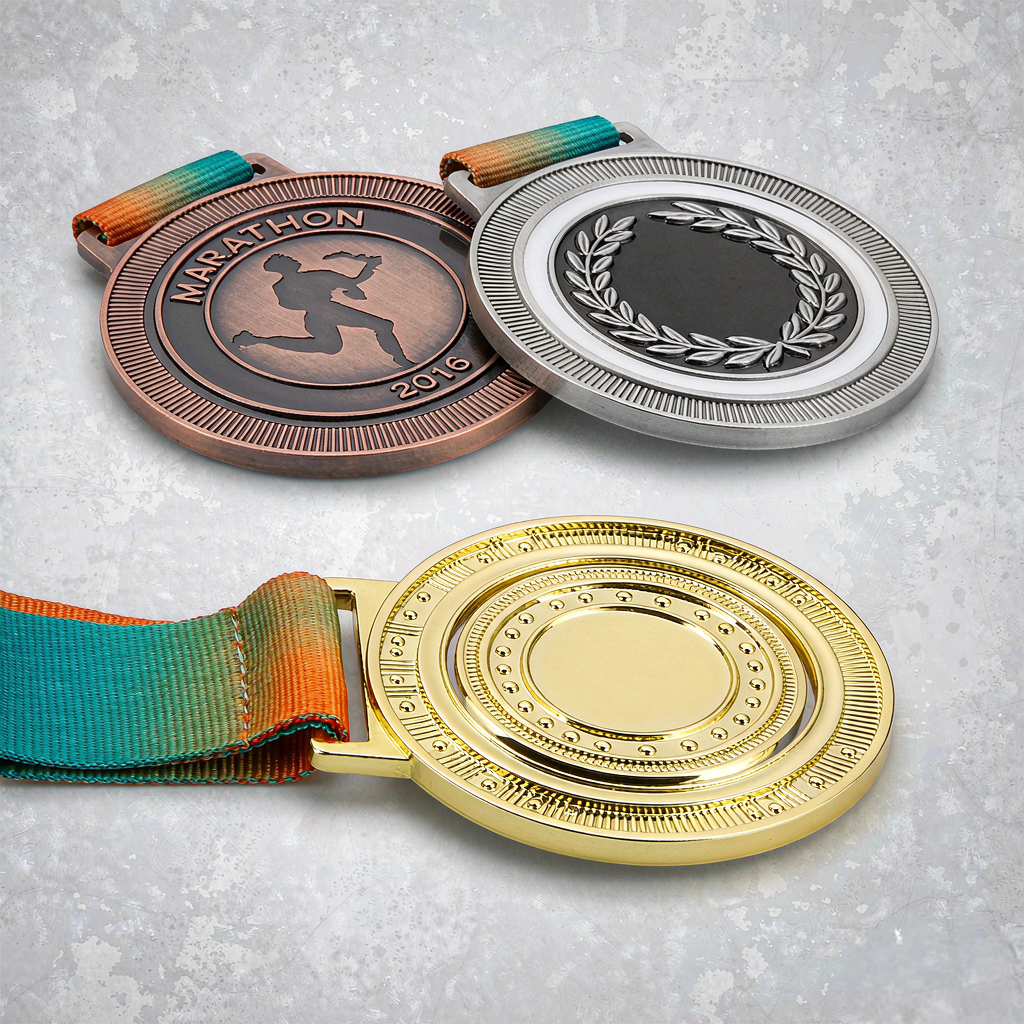
The Four Decisions Behind Every Race Medal
Almost every medal order can be described in four lines: how big it is, how the design is made, what it hangs from, and how many finishers will receive one. Directors who settle these in this order rarely have to revisit them. Directors who start with a picture and work backwards usually end up changing the artwork after the proof stage — which is the one change that is hard to absorb late in the calendar.
Think of the four lines as a specification sheet, not a shopping list. A complete sheet tells your sourcing partner everything needed to prepare a quotation and a production plan: diameter, process, ribbon treatment, quantity, and the date the medals must be in your hands. Anything left blank will be filled in by someone guessing. The sections below turn each blank into a deliberate choice.
Choosing the Size: 2", 2.5" or 3"
Size is the first decision because it sets the physical presence of the award and the weight of every piece. Match it to the significance of the distance rather than to a wish to impress. A 3" medal on a 5K feels disproportionate in the hand; a 2" medal at a marathon finish can feel small for the achievement. The table is a starting convention used across North American races, not a rule.
| Size | Typical race use | What it signals | Practical notes |
|---|---|---|---|
| 2" (50 mm) | 5K, 10K, fun runs, school events, age-group categories | Accessible, participative, youth-friendly | Lightest to wear and easiest to store in bulk |
| 2.5" (63 mm) | Half marathon, 10K main event, triathlon sprint, relay legs | The all-round standard; clearly a finisher award | Room for a date and sponsor mark without crowding |
| 3" (75 mm) | Marathon, ultra distances, podium and commemorative awards | Premium, ceremonial, display-worthy | Heavier on a ribbon; often reserved for the headline distance |
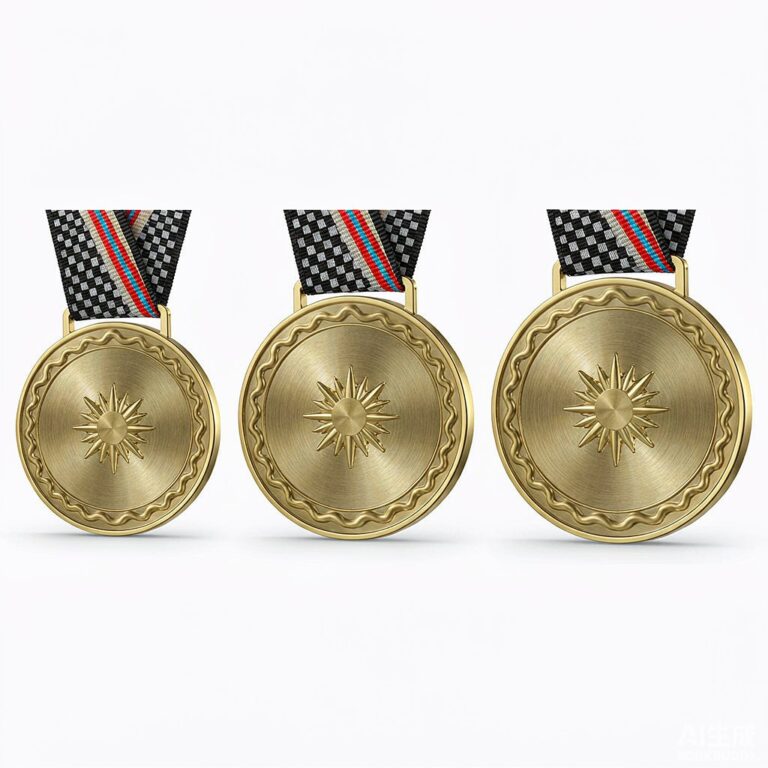
Many events use two sizes deliberately: 2.5" for the main distance and 2" for age-group or fun-run categories. That gives the headline event a distinct keepsake while keeping the smaller field consistent. Some marathons go further and reserve 3" for finishers while handing 2" to a companion 5K on the same weekend — a clean visual hierarchy that runners understand immediately, and a useful way to keep one design family across the whole event.
Check the size against the artwork, not in isolation: fine type that reads well on a screen can disappear in a smaller casting. Our guide to designing a marathon medal shows how to simplify a layout at each diameter. Send an unsure design through the quote form and ask for a size recommendation.
Metal, Weight and How a Medal Feels
Diameter gets the attention, but weight is what runners register the moment a medal is placed in their hand. Two medals of the same size can feel quite different depending on the alloy and the thickness of the casting. Zinc alloy is the common default for race medals because it holds enamel colour well and keeps a large run manageable to wear and ship. Brass is the heavier, more traditional alternative, usually chosen for commemorative pieces and long-distance finisher awards where a sense of substance is part of the point.
Thickness is the quieter variable. Standard race medals sit around 3 mm; a thicker casting changes the hand-feel without changing the visible design. Ask to hold a sample rather than judging from a specification sheet, and state the diameter when you request a quote so your sourcing partner can recommend a suitable thickness.
Plating is the final surface decision. Antique gold, antique silver and black nickel are the race standards; antique finishes hide handling marks and photograph well. Settle plating after the enamel colours, since the metal tone sets their backdrop. The case studies page shows how other events paired plating with a colour palette.
Choosing the Process: Soft Enamel, Hard Enamel or Die Struck
The process is how the design becomes metal and colour. Three finishes cover almost every race medal. They differ in texture, in how crisply they hold detail, and in how they photograph — which matters more than most directors expect, because the finisher photo is the image your next year’s field will see.
| Process | Look and feel | Detail retention | Best for |
|---|---|---|---|
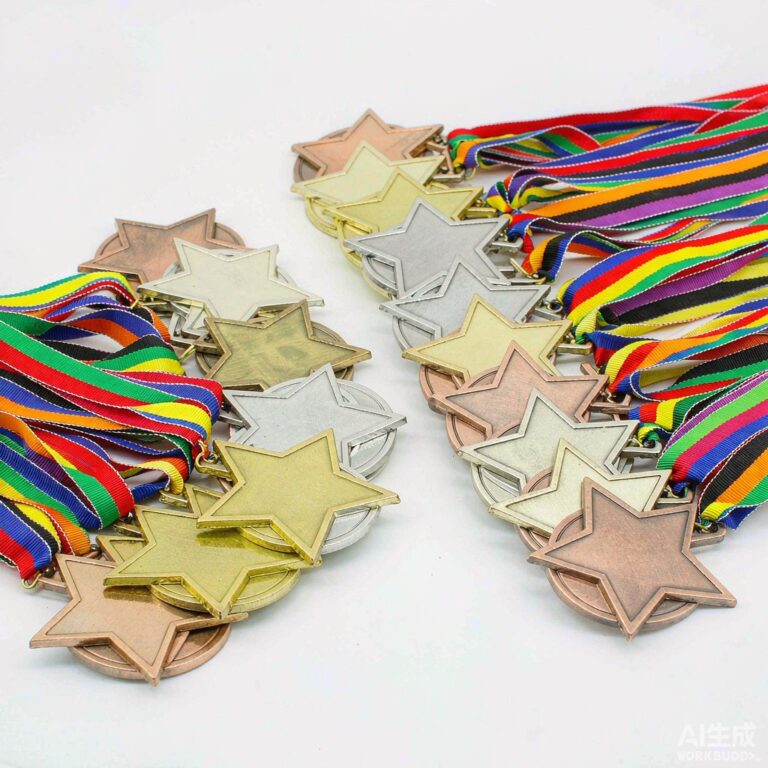
| Soft enamel | Raised metal borders with recessed colour; the classic textured race-medal finish | Excellent colour separation; borders stay crisp | Almost every race medal, from 5K to marathon |
| Hard enamel (cloisonné) | Smooth, flat, polished surface with a jewellery-like finish | Very fine; the flat face suits small type | Premium finisher awards, sponsorship presentations, commemoratives |
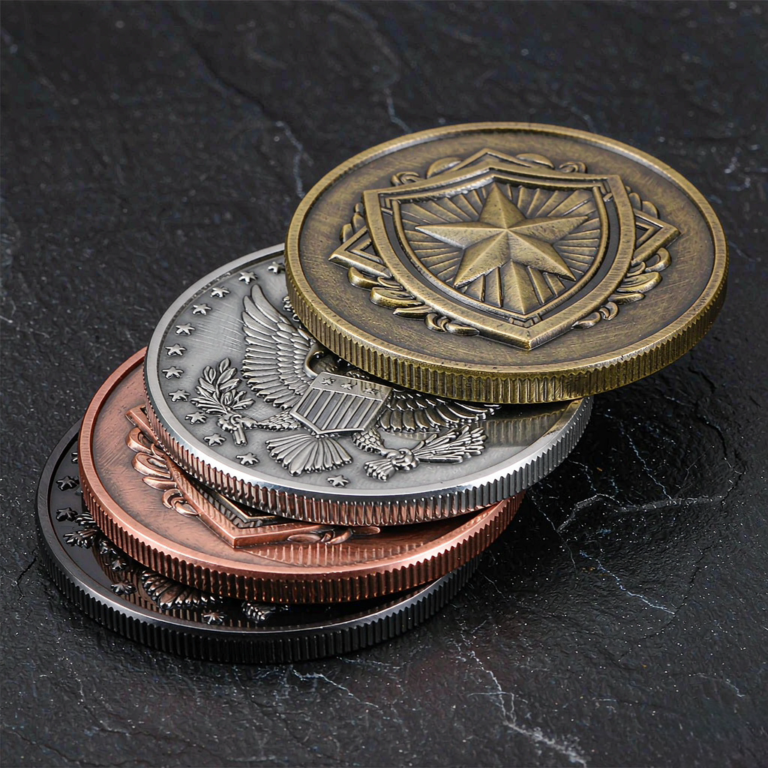
| Die struck (no enamel) | All-metal relief with an antique-plated finish | Relief-driven; shading comes from the metal, not colour | Military-style events, vintage-themed races, minimalist emblems |
For most races, soft enamel on zinc alloy is the right default: it takes colour well and reads clearly at a distance. Hard enamel suits presentation pieces such as a club championship; die struck suits relief-led designs without a colour palette.
A photograph flattens the difference between recessed and polished enamel; in the hand it is obvious, and a sample also confirms weight. We work with vetted factories and can arrange one before the main run — ask for it when you request a quote.
Ribbons, Attachments and Presentation
The medal is only half the object a runner takes home. The ribbon is what they wear for the rest of the day, and the packaging is what a sponsor sees first. Both are specified separately from the medal, and both are easy to overlook until the week before the event.
| Medal size | Recommended ribbon width | Notes |
|---|---|---|
| 2" (50 mm) | 7/8" (22 mm) or 1" (25 mm) | 1" is the race standard and gives the most room for event text |
| 2.5" (63 mm) | 1" (25 mm) or 1.25" (32 mm) | Balanced proportions; enough width for a short sponsor mark |
| 3" (75 mm) | 1.5" (38 mm) | Supports the larger medal visually; wider print area for the event name |
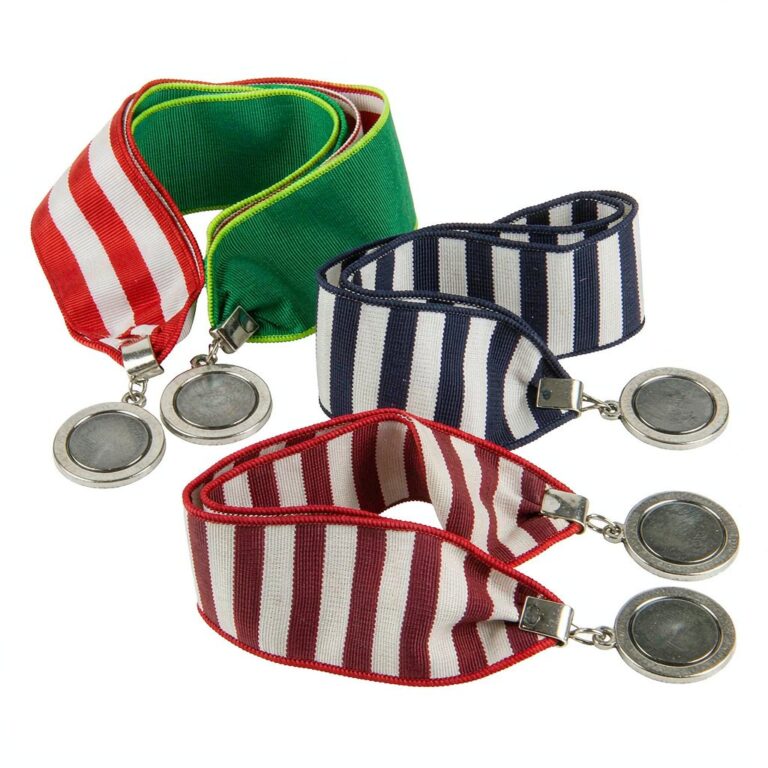
Full-colour sublimation is the normal treatment for race ribbons. Your event logo, date and sponsor marks reproduce accurately, and adding another colour to the print does not change the ribbon construction. Many directors put the event name and year on the ribbon and leave the medal face purely graphic — that keeps the metal clean and gives sponsors a second visible surface. Our medal ribbon guide covers print layout, colour choices and attachment types in detail.
- Attachment: a jump ring is standard. Consider a breakaway safety clasp for children’s events and school races, where a ribbon that catches can be a genuine safety issue.
- Ribbon finish: a plain end is fine for the finisher pile; a folded or stitched end reads more deliberately in a presentation photo.
- Packaging: individual poly bags protect the finish during transport and storage. A printed backing card adds a surface for sponsor logos and event information, and keeps the medal from tangling.
- Presentation sets: podium, VIP and sponsor awards are often presented in a pouch or box rather than on a ribbon. Treat these as a separate line in the specification, not an afterthought.
Packaging affects the race-morning handout: bagged medals can be sorted by category in advance, while loose medals need more careful handling. If volunteers staff your finish area, keep the packaging simple. The artwork guide includes print specifications for backing cards and ribbon artwork if you supply your own files.
Sponsors and the Second Surface
A race medal offers sponsors two surfaces: the backing card and the ribbon. Keep the metal face for the event identity and distance; partner logos belong on the card, which is read at presentation and again at home. Supply vector files, decide early whether sponsors share a card, and confirm with your sourcing partner when artwork must be locked.
How Many Medals to Order
Quantity is the one decision you can calculate rather than guess. Order finisher medals for 85–95% of registered runners, then add podium, age-group, volunteer and sponsor medals as separate lines on top. Most community races see 5–15% of registrants absent on race day, so ordering for every signup leaves a stack of unused medals. Running out, however, is the worse outcome: a finisher who crosses the line and receives nothing remembers it.
| Registered runners | At 85% | At 95% | How to choose |
|---|---|---|---|
| 200 | 170 | 190 | Small fields: lean high; a single extra medal is a minor addition |
| 500 | 425 | 475 | Use prior-year finisher counts if you have them |
| 1,000 | 850 | 950 | Model the spread; ten points is a meaningful range at this scale |
| 3,000 | 2,550 | 2,850 | Prior chip data matters more than any general rule here |
Use the lower end when several years of accurate finisher data show a committed field. Use the upper end for a first-time event, a family fun run, or any race with late registrations and withdrawals. Weather history moves the number too — an exposed course in a wet month behaves differently from a shaded urban loop. The full buffer method, including a worked worksheet and the five variables that shift the rate, is in our how many medals to order guide.
One habit worth building: confirm the final count at the digital-proof stage rather than at the first conversation. There is usually a window between artwork approval and the start of tooling when the number can still move. Ask your sourcing partner exactly when that window closes for your order. Once tooling begins, the die and the material plan are set, and late additions become a logistical problem rather than a line on a form.
Your 12-Week Countdown to Race Day
Medal programs fail on timing far more often than on quality. The safe pattern is to work backwards from race day and treat artwork approval as the stage you control. Production itself is the least flexible part of the schedule; everything before it can be accelerated with prompt decisions.
| Weeks out | Milestone | What to watch |
|---|---|---|
| 12 | Lock the concept, size and process; gather quotations from two or three sourcing partners | Decide the headline distance and any second size now |
| 10 | Confirm the partner; submit final vector artwork | Check that type is legible at the chosen diameter |
| 8 | Approve the digital proof; confirm quantity and packaging | This is the last comfortable point to change the count |
| 7 | Tooling begins — the die is cut for your design | Changes after this point are disruptive |
| 6 | Review a physical sample, if requested | Verify weight, enamel colour and ribbon print together |
| 4 | Mass production and quality checks under way | Ask for checkpoint photos if you want visibility |
| 2 | Shipping to your address | Confirm the delivery address and receiving contact |
| 0 | Medals in hand several days before the event | Buffer time for sorting and repacking by category |
Week numbers shift with the supplier and season, so treat the table as a planning frame rather than a promise. Artwork and approval are flexible; production is not. For an April event, start the conversation in late December at the latest and put the in-hands date in writing on the quotation.
For a deeper walkthrough of the production sequence, including the points where a schedule can compress, see the race medals program page. Real examples of how other events handled the same window are collected on our case studies page.
Designing for a Die You Can Reuse
Leftover medals are not necessarily wasted. If the core design survives next year with only a ribbon print or a backing-card date changed, the same die serves again and the whole specification stays familiar to runners. That is a design decision made at the start, not a happy accident at the end.
Keep the year, the event name and any sponsor marks out of the central emblem. Put the date on the ribbon, where it can be reprinted without touching the metal. Avoid a layout built around a single edition’s theme if you expect to run the event annually. Our artwork guide sets out the file formats and line-weight rules that make a design durable across reorders.
- Legibility first. Event name and year must be readable at arm’s length; fine text under about 1 mm tends to disappear in casting.
- 2D usually beats 3D for races. Strong contrast in a flat relief photographs better and stays clearer at small diameters; sculpted depth is better reserved for emblem-led commemoratives.
- Design for the ribbon. Choose ribbon colours from the medal palette. A runner sees the two as one object.
- Keep a master file. Store the vector artwork, the approved proof and the ribbon layout together so next year’s reorder starts from a settled specification.
How a Sourcing Partner Works on a Race Medal Order
MedalSmith is a sourcing partner and custom metal specialist, not a factory. We work with vetted factories and manage the specification, proofing and production schedule on your behalf. In practice that means one point of contact for the design question, the sample, the production updates and the delivery — instead of coordinating those steps yourself across a production floor.
The process starts with your artwork and race date. We check the design against the chosen diameter, flag anything that will not reproduce cleanly, and prepare a digital proof. Once approved, the die is cut and a sample can be arranged before the main run. During production you receive checkpoint updates. Your quotation sets out the specification item by item and states an expected in-hands date — ask for it in writing when you request a quote.
Because a medal’s specification changes with size, process, finish and quantity, we do not publish a single figure that would be wrong for most orders. Send your specification instead: diameter, finish, ribbon treatment, approximate count and race date. The quote form is the quickest route, and the ordering FAQ answers the common process questions before you fill it in.
Questions to Settle Before You Request a Quote
- What is the race date, and when must the medals be in your hands? Give a date, not just a season.
- Which distance is the headline event? This sets the size hierarchy for the whole order.
- What finish do you want, and do you have vector artwork? If not, say so — layout help can be arranged.
- What is your best estimate of finishers, and what is your no-show assumption? Write the assumption down.
- Who receives a medal besides runners? Podium, age groups, volunteers, pacers and sponsors each need a separate line.
- How will medals be handed out? Bagged, boxed or on a ribbon — this affects the packaging specification.
A director who arrives with these answers gets a useful quotation quickly; one who arrives with a JPEG and a race date gets a conversation instead.
Common Mistakes Race Directors Make
- Specifying the size before the artwork is checked. A design that works at 3" may not work at 2". Test the layout at the real diameter.
- Ordering for every registered runner. No-shows are normal; a small, deliberate buffer is better than a large leftover pile.
- Folding volunteers and sponsors into the runner count. They are separate populations with separate drivers.
- Approving a proof slowly, then asking to compress production. Production has a floor; approval does not.
- Putting the year into the metal. It makes the die single-use and turns a small surplus into dead stock.
All are easier to fix on paper than in production, before tooling starts.
Key Takeaways
- Specify race medals in four lines — size, process, ribbon and quantity — then work backwards from race day.
- Start 10–12 weeks ahead; production is the least compressible stage, while artwork and approval are flexible.
- Use 2" for 5K/10K and age groups, 2.5" for half marathons and main events, and 3" for marathon finishers and podium awards.
- Soft enamel on zinc alloy suits most races; hard enamel suits premium presentations and die struck suits relief-led designs.
- Order finisher medals for 85–95% of registrations and add podium, volunteer and sponsor medals as separate lines.
- Keep the year off the metal so the die can be reused and leftover ribbons stay useful.
FAQ
What size medal should a marathon use?
3" (75 mm) is the common choice for a marathon finisher medal, because the distance warrants a substantial keepsake. Many races pair it with a 2.5" medal for a half marathon or companion 10K on the same weekend. If the design is text-heavy, a well-planned 2.5" medal reads better than an overcrowded 3" one — check the artwork at full size before deciding.
When should a race director order medals for a spring race?
Start 12 weeks before race day, which for an April event means late December or early January. Confirm the partner by 10 weeks, approve the proof by 8 weeks and expect the die to be cut around 7 weeks. The medals should be in your hands several days before the event so there is time to sort them by category.
Can the same medal design be reused next year?
Yes. Keep the core emblem, shape and border without the year text, and put the date on the ribbon or backing card instead. The die then serves another run and the artwork stays familiar to returning runners. Store the vector master and approved proof together so the reorder starts from a settled specification.
Do I need a physical sample before production?
It is worth requesting, particularly for a first order with a new design. A proof shows the layout; a sample shows the weight, the enamel texture and the ribbon colours together. Approve the digital proof first, then review the sample before the main run. Ask your sourcing partner to include a sample in the quotation.
How do I get a quote for a custom race medal?
Send the diameter, finish, ribbon treatment, approximate finisher count and your race date through the quote form. An itemized quotation will set out each part of the specification and the expected in-hands date. If the artwork is not final, say so — a size and process recommendation can come first.
Last updated: November 2026.
Planning a race? Send your specification through the quote form and lock the production window before the calendar forces a rushed decision. More process answers are in the medal ordering FAQ.