Medal Ribbon Guide: Width, Color, Attachment & Printing
Standard medal ribbon width is 1 inch (25 mm) for most race medals. Use 7/8 inch (22 mm) for 2-inch pieces, 1 inch for 2.5-inch medals and 1–1.5 inches for 3-inch medals. Ribbon also carries your event name, year and sponsor marks in full-colour print. This guide covers width, colour, attachment and printing, with the limits that matter in production.
Runners wear the ribbon for the whole event and see the medal face mainly at the finish. That makes the ribbon half the product, yet it is usually specified last and from a catalogue rather than a plan. The four decisions below are straightforward once you know the physical limits. For the wider design context, see our marathon and race medals buyer’s guide.
Standard Medal Ribbon Width by Medal Size
| Medal diameter | Recommended width | Why | Typical use |
|---|---|---|---|
| 1.5–1.75" (38–44 mm) | 7/8" (22 mm) | A wider strap visually overwhelms a small medal | Youth events, small awards |
| 2" (50 mm) | 7/8"–1" (22–25 mm) | Balanced proportion; comfortable for a light piece | 5K, 10K, age-group medals |
| 2.5" (63 mm) | 1" (25 mm) | The race standard; enough face for printed text | Half marathons, main events |
| 3" (75 mm) | 1"–1.5" (25–38 mm) | Distributes a heavier medal across the neck | Full marathons, ultras |
| Oversized or shaped | 1.5" (38 mm) | Extra mass needs a wider bearing surface | Special editions, podium pieces |
One inch is the default for a reason: it carries print legibly, suits the most common medal sizes and sits comfortably under a race bib. Go narrower only on small medals; go wider only when the medal is genuinely heavy.
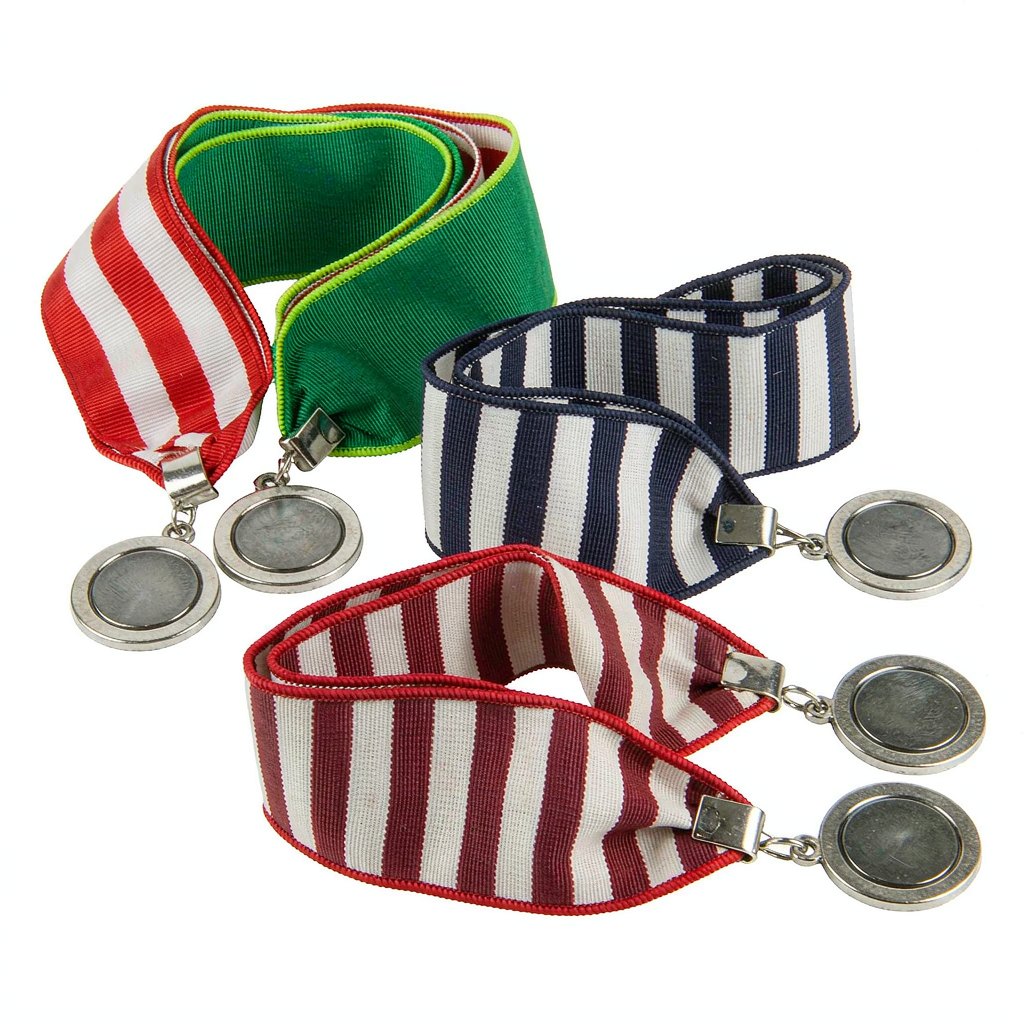
Why Width Matters Beyond Appearance
Width is a comfort decision as much as a visual one. A heavy medal on a narrow strap concentrates weight into a small area, which digs into the neck and encourages the ribbon to twist. During a marathon, that twist means the medal face ends up turned sideways for most of the race — and sideways is how it appears in photos.
Three practical effects follow from width:
- Weight distribution. A 1.5-inch ribbon spreads a 3-inch medal’s weight more comfortably than a 7/8-inch strap.
- Print legibility. Event name and sponsor marks need real surface area. A narrow ribbon forces smaller text, which disappears in photographs.
- Stability. Wider ribbon lies flatter against a shirt and resists rolling at the edges.
If your medal weight is rising, raise the ribbon width in the same specification review. Treating them as separate decisions is a common cause of finish-line discomfort.
Colour: Build the Ribbon From the Medal Palette
The ribbon and medal are seen together, so they should read as one object. The simplest method is to pull one enamel colour from the medal and carry it into the ribbon background, then use the ribbon print for the event name and year.
- Match one colour, not all of them. Repeating every enamel colour on the ribbon makes both pieces busy. One shared colour is enough to create a set.
- Use a dark background for light print. Navy, black and deep green carry white or yellow text clearly at a distance.
- Reserve contrast for the year. The year is the detail most often photographed. Give it the highest contrast on the ribbon.
- Check the colour under race lighting. A ribbon photographed at dawn under overcast skies reads differently from one under studio lights.
Full-colour sublimation printing has no per-colour constraint, so there is no technical reason to limit the palette — only a design reason. Restraint reads better on a small strip of fabric.
Printing: What Sublimation Can and Cannot Do
Sublimated ribbon print is the standard for race medals. It reproduces full-colour artwork across the ribbon face, including gradients and fine lines, and it is durable enough for an event day. It does have physical limits.
| Element | Guidance | Reason |
|---|---|---|
| Text height | Keep names and years bold and large for the width | Fine text blurs at fabric resolution and in photos |
| Repeating logos | Space them evenly; avoid cropping at the fold | The fold point is where the ribbon bends |
| Sponsor marks | Group them in a clear band, not scattered | Scattered marks read as visual noise |
| Colours | Use high contrast between print and background | Event photography is rarely perfectly lit |
Supply ribbon artwork as vector files with fonts outlined, using the same standards as the medal artwork. Our artwork guide lists the accepted formats. Because print is applied to a continuous roll, confirm where the repeat begins and ends before approving the proof — a logo split at the fold is a common surprise.
Attachment Options
| Attachment | How it works | Best for | Check |
|---|---|---|---|
| Jump ring | Metal ring through the medal’s top hole | Standard for all race medals | Ring must be fully closed; a gap catches on fabric |
| Breakaway clasp | Ribbon ends release under pull | Children’s events, school races | Test that it releases under load but not during normal wear |
| Safety-pin back | Pin fixes ribbon to a bib or shirt | Keeping the medal face forward | Ensure the pin does not snag the fabric |
| Barb or toggle | Ribbon fastens at the neck without a clip | Ceremonial and presentation pieces | Less common; confirm availability at the quote stage |
For most races, a properly closed jump ring is all that is needed. Ask for it to be checked at the packing stage — an open ring is a small defect that ruins the entire presentation for one runner.
Ribbon Length and End Finish
Ribbon is supplied folded, and length is measured from the fold to the ends. A common finished drop is around 30–36 inches (76–91 cm) total, which suits most adults when worn around the neck. Shorter lengths suit children; longer lengths suit runners who wear the medal over a jacket.
End finish is easy to overlook. Options include a clean straight cut, a V-notch cut and a sewn edge. A V-notch reads as finished and is the most common choice for race ribbons. Check that both ends are cut evenly — uneven ends are visible in the finish-line photographs that matter most.
Common Ribbon Mistakes
- Specifying ribbon last. Width affects print area and comfort, so decide it with the medal size, not after artwork is locked.
- Putting too much text on a narrow strap. Sponsor names, event name and year cannot all read clearly at 7/8 inch.
- Ignoring the fold point. A logo that straddles the fold is distorted when the ribbon is worn.
- Forgetting the year’s reusability. Put the year on the ribbon, not the medal, so the die stays usable next edition.
- Skipping the attachment check. An open jump ring loses the medal before the runner reaches the photo line.
The race medals program page covers how ribbon, attachment and packaging are checked together before shipment, and the custom medals page lists the standard combinations.
Key Takeaways
- One inch (25 mm) is the standard race ribbon width; use 7/8 inch on small medals and 1.5 inches on heavy ones.
- Wider ribbon distributes weight better, keeps the medal face forward and gives print more room.
- Choose ribbon colour from one enamel colour in the medal so the two read as a set.
- Full-colour sublimation has no per-colour limit, but text must be bold and positioned clear of the fold.
- Specify a fully closed jump ring and check ribbon ends and length at the packing stage.
FAQ
What is the standard medal ribbon width?
One inch (25 mm) is the standard for most race medals. Smaller 2-inch pieces often use 7/8 inch (22 mm), and heavy 3-inch medals may use 1.5 inches (38 mm) for comfort and stability.
How long should a medal ribbon be?
A finished drop of roughly 30–36 inches (76–91 cm) total suits most adults wearing a medal around the neck. Use shorter ribbon for children’s events and longer pieces if runners will wear the medal over outerwear.
Can you print sponsor logos on the ribbon?
Yes. Full-colour sublimation carries logos, event names and years without a per-colour limit. Group sponsor marks in a clear band and keep the year at high contrast. Supply vector files with fonts outlined.
What attachment is standard for a race medal?
A closed jump ring through the medal’s top hole is standard. For children’s events, a breakaway clasp adds a safety release. Whichever you choose, confirm the ring is fully closed at packing.
Should the year go on the ribbon or the medal?
On the ribbon. The die is dedicated to the metal design, so keeping the year off the medal lets the same tooling serve future editions while only the ribbon print changes.
Last updated: November 2026.
Specifying ribbon for an upcoming event? Request a custom quote with your medal size and artwork, and we will confirm the width, print layout and production window. More questions are answered in the medal FAQ.