Marathon Medal Sizes: 2″ vs 2.5″ vs 3″ — Which to Choose?
What size should a marathon medal be? For a full marathon, choose 3 inches (75 mm). A half marathon usually takes 2.5 inches (63 mm), and 5K or 10K events use 2 inches (50 mm). Match the diameter to the distance so the medal signals the achievement before anyone reads it. This guide covers weight, detail capacity, ribbon pairing and the cases where going off-standard makes sense.
Size is the first specification a race director sets and the hardest one to change later, because it determines the die, the artwork layout and the ribbon. Get it right early and the rest of the design follows naturally. The full decision path is in our marathon and race medals buyer’s guide.
What Size Should a Marathon Medal Be? The Distance Rule
The working rule is simple: medal diameter should rise with distance. A runner who has just covered 26.2 miles should not receive the same object as someone who finished a 5K. The size difference communicates respect for the effort before a single word is read.
That rule is a convention, not a law, but conventions matter here. Runners collect medals, compare them, and photograph them side by side. A medal that follows the expected size for its distance fits that collection cleanly; one that does not looks either under-scaled or inflated.
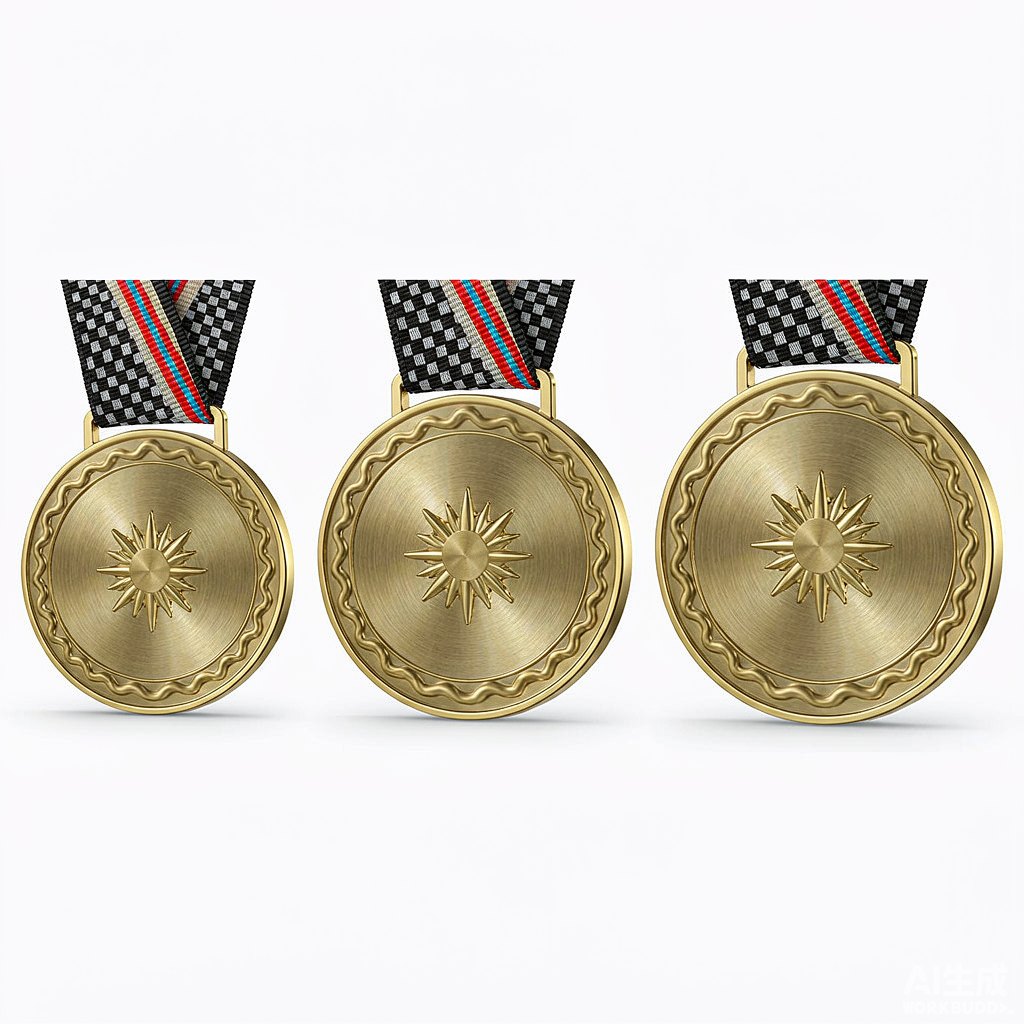
The Three Sizes Compared
| Diameter | Best for | Feel on the ribbon | Detail capacity | Usual thickness |
|---|---|---|---|---|
| 2" (50 mm) | 5K, 10K, fun runs, age-group awards | Light; barely noticed after the first mile | Emblem, short name, one date line | 3 mm |
| 2.5" (63 mm) | Half marathon, main 10K, sprint triathlon | Present but comfortable; the middle ground | Emblem, two text lines, secondary graphic | 3–4 mm |
| 3" (75 mm) | Full marathon, ultra finish, podium awards | Substantial; rests flat against the chest | Course outline or skyline plus full text set | 3–4 mm |
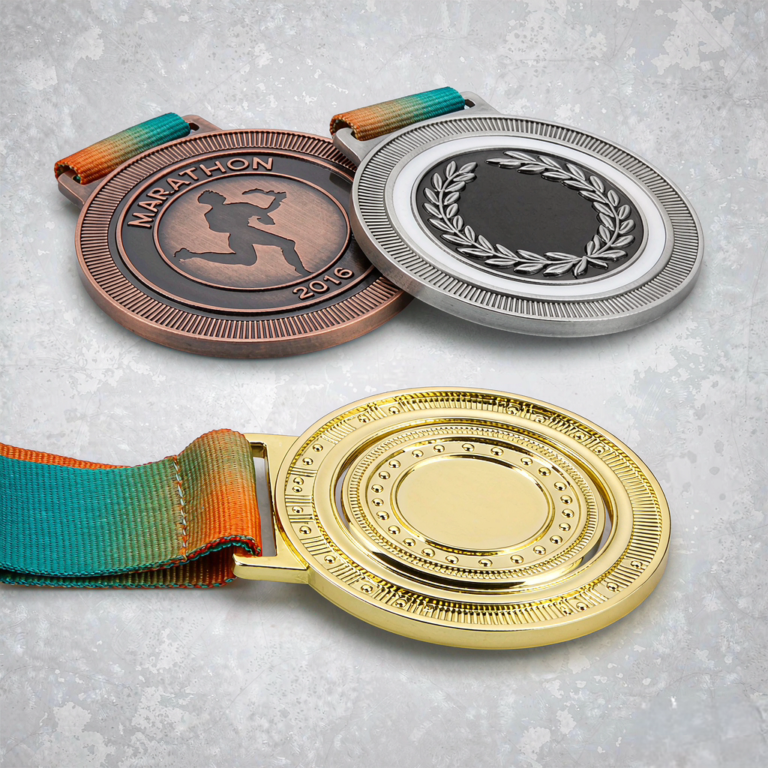
The 3-inch size is the marathon default because it is the smallest diameter that comfortably carries a real composition. A course line, a city silhouette, the race name, the distance and the year can all coexist without shrinking any one of them to a squint. At 2 inches, that same set becomes a compromise.
Weight: What the Extra Inch Actually Feels Like
Diameter is only half the story. Weight scales with area, so moving from 2 to 3 inches adds far more than one inch of metal — the surface grows by roughly 125%. In practice:
- A 2-inch die-cast medal is light enough that most runners forget it is there after the first mile.
- A 2.5-inch medal has a noticeable presence without pulling on the ribbon.
- A 3-inch medal sits flat and substantial against the chest. For a marathon this is appropriate — it feels like an object that marks something.
Thickness compounds the effect. A 3 mm piece is standard; 4 mm adds depth to relief and a heavier hand-feel. For a full marathon, 3 mm at 3 inches is usually enough. Go thicker for podium and ultra pieces where the object will be displayed rather than worn for hours.
Because weight rises with diameter, it also affects how the ribbon and attachment behave. A heavier medal on a narrow ribbon twists and folds. Match the strap to the piece, as described below.
Detail Capacity: What Fits at Each Diameter
Every size has a practical ceiling for text and line work. Designing past that ceiling is the most common reason a proof looks good on screen and disappointing in metal.
| Diameter | Comfortable text | Safe artwork approach | Avoid |
|---|---|---|---|
| 2" | Race name + year, 1–2 words of motto | Bold emblem, simple border, high contrast | Course maps, multi-line mottos, fine serif faces |
| 2.5" | Race name + distance + year + short motto | Emblem with one secondary graphic | Dense skylines with more than a few landmarks |
| 3" | Full text set + event branding + reverse detail | Course outline or skyline, separated text zones | Text below about 1 mm height, hairline borders |
Across all sizes, keep raised text around 1 mm minimum and enamel colour bands around 0.8 mm. Those are physical limits of casting and colour fill, not stylistic preferences. The artwork guide lists the file requirements that go with them.
Ribbon Width and Attachment by Size
| Medal size | Recommended ribbon width | Attachment | Note |
|---|---|---|---|
| 2" | 7/8" (22 mm) or 1" (25 mm) | Jump ring | A wide strap overwhelms a small medal |
| 2.5" | 1" (25 mm) | Jump ring | The race standard; works with full-colour print |
| 3" | 1" (25 mm) minimum, 1.5" (38 mm) for heavy pieces | Jump ring, check closure | A narrow strap can dig in under a 3-inch weight |
Full-colour sublimated ribbon print has no per-colour constraint, so the ribbon can carry the event name, year and sponsor marks without stealing space from the medal face. This is the main reason to put the year on the ribbon rather than the metal: it keeps the die reusable for future editions. Our custom medals page shows the standard ribbon and attachment combinations.
When to Go Off-Standard
Most races should stay inside the three standard sizes. There are three situations where deviating is reasonable:
- Ultra distances. A 50K or 100-mile event may justify 3.5 inches or a shaped oversized piece, because the achievement is genuinely singular and the medal will usually be displayed.
- Presentation awards. Overall winners and age-group trophies can be a size above the finisher medal, giving the award ceremony a visible hierarchy.
- Small or junior events. A children’s fun run can use a 1.75-inch piece; a full 3-inch medal on a child is awkward and uncomfortable.
Whatever you choose, check the design at that exact diameter. Scaling artwork between sizes is not a neutral operation — elements that read well at 3 inches frequently collapse at 2.
Multi-Distance Events: Use Size as a Hierarchy
If your event offers several distances, size is the cleanest way to differentiate. A common and well-understood set:
- 5K — 2 inches
- 10K — 2 inches, different shape or colour
- Half marathon — 2.5 inches
- Full marathon — 3 inches
Keeping the 5K and 10K at the same diameter simplifies artwork and storage while still letting the ribbons differ. The jump from 2.5 to 3 inches at the marathon mark gives that distance its own visual status. For quantity planning across the whole field, see the race medals program page.
Key Takeaways
- Full marathons use 3 inches (75 mm); half marathons 2.5 inches; 5K and 10K events 2 inches.
- Weight rises with area, so a 3-inch piece is far heavier than a 2-inch one even at the same thickness.
- Three inches is the smallest size that carries a full composition of course, text and branding.
- Match ribbon width to diameter: 7/8–1 inch for smaller pieces, 1–1.5 inches for a 3-inch medal.
- Go off-standard only for ultras, presentation awards or junior events — and redesign the artwork at that size.
FAQ
What size should a marathon medal be?
Three inches (75 mm) at 3–4 mm thickness is the standard for a full marathon. It carries a full design and feels proportionate to the distance. Half marathons typically use 2.5 inches and shorter races 2 inches.
Is a 2.5-inch medal acceptable for a full marathon?
Yes, and some races choose it for comfort or to keep a consistent look across distances. It works if the artwork is designed specifically for 2.5 inches. Do not simply shrink a 3-inch layout — redraw it so text and shapes stay legible.
How much heavier is a 3-inch medal than a 2-inch one?
At the same thickness, a 3-inch disc has roughly 2.25 times the face area of a 2-inch disc, so the weight difference is substantial. Plan the ribbon width and attachment accordingly; a narrow strap under a heavy medal twists during a race.
What ribbon width suits a 3-inch medal?
One inch is the minimum and works well for most designs. If the medal is 4 mm thick or die-cut into an oversized shape, 1.5 inches spreads the weight more comfortably across the neck.
Can we use different sizes for different distances?
Yes, and it is recommended. A 2-inch short-course medal, 2.5-inch half and 3-inch full give runners an instant visual hierarchy. Keep the core emblem consistent across them so the series still reads as one event family.
Last updated: November 2026.
Choosing between 2, 2.5 and 3 inches for an upcoming event? Request a custom quote with your distance and concept, and we will confirm the die, ribbon and production window. More specification questions are answered in the medal FAQ.